





Privacy-preserving analytics for medical research
PrivateAIM develops FLAME, a federated platform that brings the analysis to the data at German university hospitals.
- Funded by the BMFTR
- Part of the Medical Informatics Initiative
- Open source

What is PrivateAIM?
PrivateAIM (Privacy-Preserving Analytics in Medicine) is a research consortium of 15 partners within Germany’s Medical Informatics Initiative (MII), funded by the Federal Ministry of Research, Technology and Space (BMFTR) from April 2023 until 31 March 2027. It develops FLAME (Federated Learning and Analysis in Medicine), an open-source platform in productive use that analyzes medical data across university hospitals: patient data stays at each site, only the analysis code travels to the data, and only aggregated results are returned.
Medical research, and AI in particular, needs data from many hospitals to produce reliable results. But health data is sensitive and strictly protected. Federated analysis resolves this conflict: instead of collecting data centrally, researchers send their analysis to the data.
Project at a Glance
- Funding
- BMFTRFederal Ministry of Research, Technology and Space (BMFTR)
- Network
- 15 partnersfrom all four consortia of the Medical Informatics Initiative (MII)
- Platform
- FLAMEin productive use
- Regular project end
- 202731 March 2027
- Code
- Open sourceon GitHub
How It Works
- 1
Data Remains Local
Patient data stays at each participating site and is never transferred to a central system or to other sites.
- 2
Code to Data Approach
Analysis code travels to the data, and each site reviews and approves it before it runs.
- 3
Federated Analysis
Only aggregated results are returned: the results of the sites are combined, and only this combined result is made available to the researcher.
Experience FLAME
Our platform for secure distributed medical data analysis
What you can do with FLAME
Statistics and cohort counts
Count cohorts and compute descriptive statistics across sites, on FHIR data such as the MII core dataset or on files such as CSV or VCF.
Federated learning
Train machine learning models over several rounds, while the training data never leaves the participating hospitals.
Privacy-enhancing technologies
Add local differential privacy to the results, or use homomorphic encryption so that only the combined result of all sites is visible.
Your own Python analysis
Write your analysis in Python with the FLAME SDK, test it locally and choose a master image with the dependencies you need.
Example analyses in the FLAME documentation cover long COVID (PASC), survival regression, logistic regression, image classification and quality control of genomic data.
Latest News
All news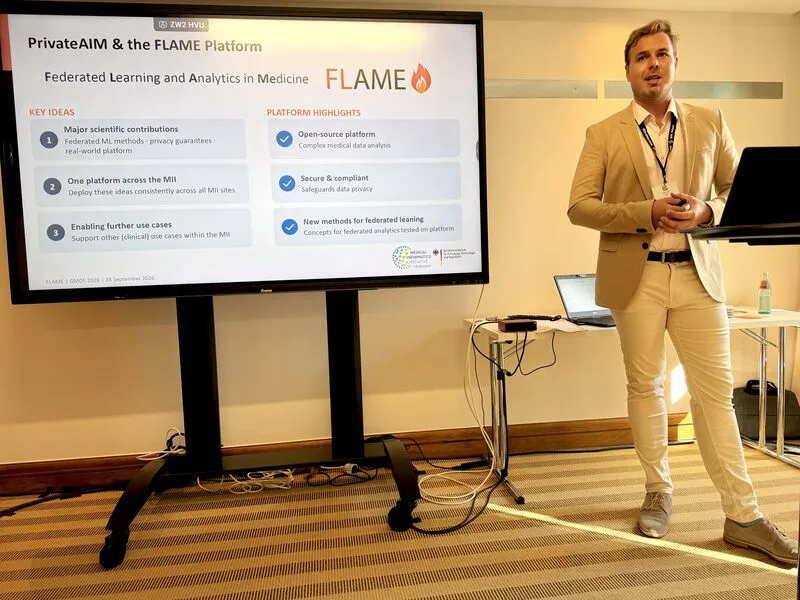
ISCB-GMDS 2026 in Freiburg
From September 27 to October 1, 2026, the joint annual conference of the German Association for Medical Informatics, Biometry and…
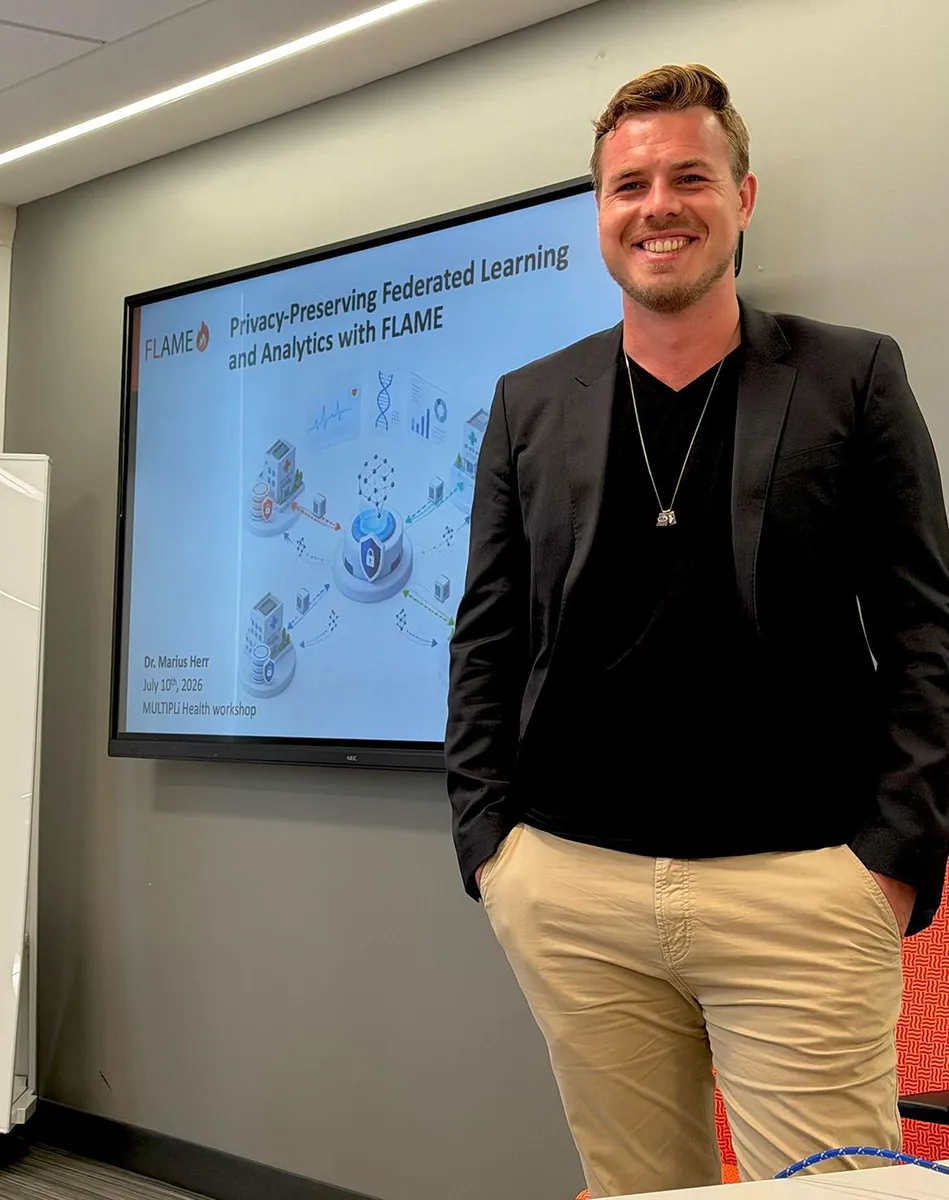
AIME 2026 in Ottawa
From July 7 to 10, 2026, the International Conference on Artificial Intelligence in Medicine (AIME) took place in Ottawa, Canada. For more…
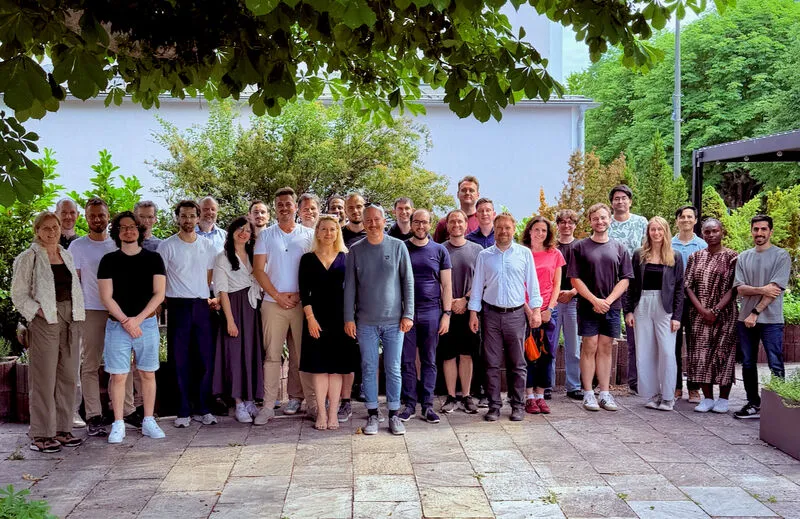
Retreat 2026 at Lake Ammersee
From June 17 to 19, 2026, the PrivateAIM consortium met for its seventh annual retreat in Herrsching at Lake Ammersee. Partners from all 15…
Our Mission
PrivateAIM (Privacy-preserving Analytics in Medicine) is dedicated to bridging the gap between data privacy and medical innovation. Following the "Code to Data" principle, patient data stays at each participating site: only analysis code travels to the data, and only aggregated results travel back.
Every site reviews and approves the analysis code before it runs. Because aggregation alone does not guarantee anonymity, this review also assesses whether the returned results are appropriate, supported by safeguards such as end-to-end encrypted exchange between sites and optional local differential privacy.
FLAME (Federated Learning and Analysis in Medicine) is at the heart of our initiative. It is the platform developed by PrivateAIM for secure distributed analysis of medical data within the Medical Informatics Initiative (MII).
Our Vision
We envision a future where AI-driven medical research is seamlessly integrated with privacy-by-design principles. PrivateAIM is pioneering a new standard for secure, federated medical AI by fostering a collaborative network of hospitals, researchers, and patients.
PrivateAIM actively involves patients, partners, and the public through workshops, educational materials, and open dialogue to ensure broad acceptance and transparency. We aim to demystify AI and federated learning, making their safeguards, limits, and benefits understandable.
With FLAME, PrivateAIM provides the MII with a secure and scalable solution for cross-institutional medical data analysis that is in productive use. We are shaping the future of trustworthy and impactful medical research by enabling AI-driven healthcare innovations while preserving patient privacy.
Open Source Contributions
Explore our code repositories and contribute to the future of privacy-preserving medical data research.
Visit GitHub →Frequently asked questions
Does patient data leave the hospital?
No. Every participating site runs a FLAME Node next to its own data. Only the analysis code travels to the data, and only aggregated results are returned. The central FLAME Hub never has access to patient data.
Are the results anonymous?
Aggregation alone does not guarantee anonymity. That is why every site reviews each analysis before it runs, including whether its results are appropriate. Local differential privacy and homomorphic encryption can add further protection. The FLAME page describes the safeguards and their limits.
Who can use FLAME?
Researchers submit analyses through the FLAME Hub. University hospitals and other institutions take part by running a FLAME Node and decide for each project whether they participate. The FLAME page has entry points for researchers, sites, data protection officers and patients.
Is FLAME open source?
Yes. The source code of the FLAME Hub and Node is publicly available on GitHub, and the documentation explains installation and use.
Who is behind PrivateAIM?
PrivateAIM brings together 15 partners from all four consortia of the Medical Informatics Initiative (MII), coordinated by the University Hospital Tübingen, the Berlin Institute of Health at Charité and the Technical University of Munich. The project is funded by the BMFTR until 31 March 2027.